Our opening socialising chat, in which we shared health updates (one participant is recovering from a major operation) set the pattern for the evening, in which one story naturally led to another one-or-two thematically-related tales. A personal story about Sai Baba and his healing powers led to two other participants sharing stories related to him.
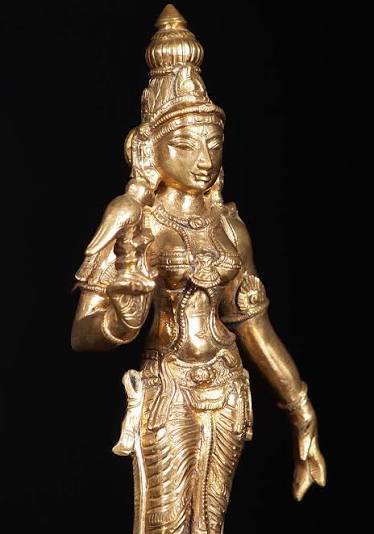
Lavanya then ‘just read’ a story she wrote 13 years ago(!) inspired by Meenakshi, a warrior princess from Tamil mythology who had three breasts, and gave one up when she met her future husband. In the process, she becomes shy and coy, no longer the warrior. Lavanya’s daughter (aged 8 at the time) had asked why? Why give up the third breast, and why did that mean giving up being a warrior woman?
It’s a story Lavanya recently re-discovered and which she wants to tell, so the reading aloud was an important first step. The group felt it was a powerful and engaging story, rich in symbol and metaphor (such as how our physical appearance shapes our identity, the need to conform to societal expectation, a woman’s public/personal roles.)
As is often the case with original narratives, or shaping a tale not from the oral tradition, our feedback focused on restructuring the narrative, particularly as Lavanya is concerned to make the story accessible for international audiences (eyeing a future festival appearance?!) Where do you begin? Lavanya’s very contemporary re-telling has several principal characters, so whose point of view do you tell it from? How do you switch from character to another? We talked about using role signifiers and ways of staging the telling (to demarcate the present and the past, for example).
Discussing themes in Lavanya’s story led me to talk about my hemiplegia (a mild spasticity that affects my right side) and my classic club-foot (my podiatrist took a photo to share at his lecture for trainee doctors!) Sentenced to 10 years at a boys’ boarding school, I was often mocked for my limp and my physical weakness, and naturally I resented my infirmity. However, heavily favouring my left side throughout my life has resulted in stimulating the right side of my brain (apparently its visibly larger on a scan than my left!) It’s the right brain which is responsible for creativity and spontaneity. So all the time I was berating my body growing up, it was in fact shaping me to be much of the person I’ve become!
Several members then shared their experiences as left-handed people, including how they were forced to write with their right hands in the past. Our conversation explored how cultural pressures to conform to right-handedness affected creativity and brain development, with Hideko mentioning research about the connection between brain hemispheres and creativity, particularly in women.
Renu then shared a story about how fire came to humans, based on a tale by Mara Menzies – a gripping telling, especially when fire came down the mountain devouring everything in its path. Our feedback led to sharing about other fire-bringing stories, such as Grandma Spider brings the light (Cherokee native American) and the Rainbow bird, which in turn led me to talk about the south American (Ecuador) tale of the brave grey parrot which tries to put out a raging forest fire and is rewarded when it flies through the rainbow, transforming its plumage.
It was a fascinating session, rich in stories and inter-personal and inter-cultural connection.